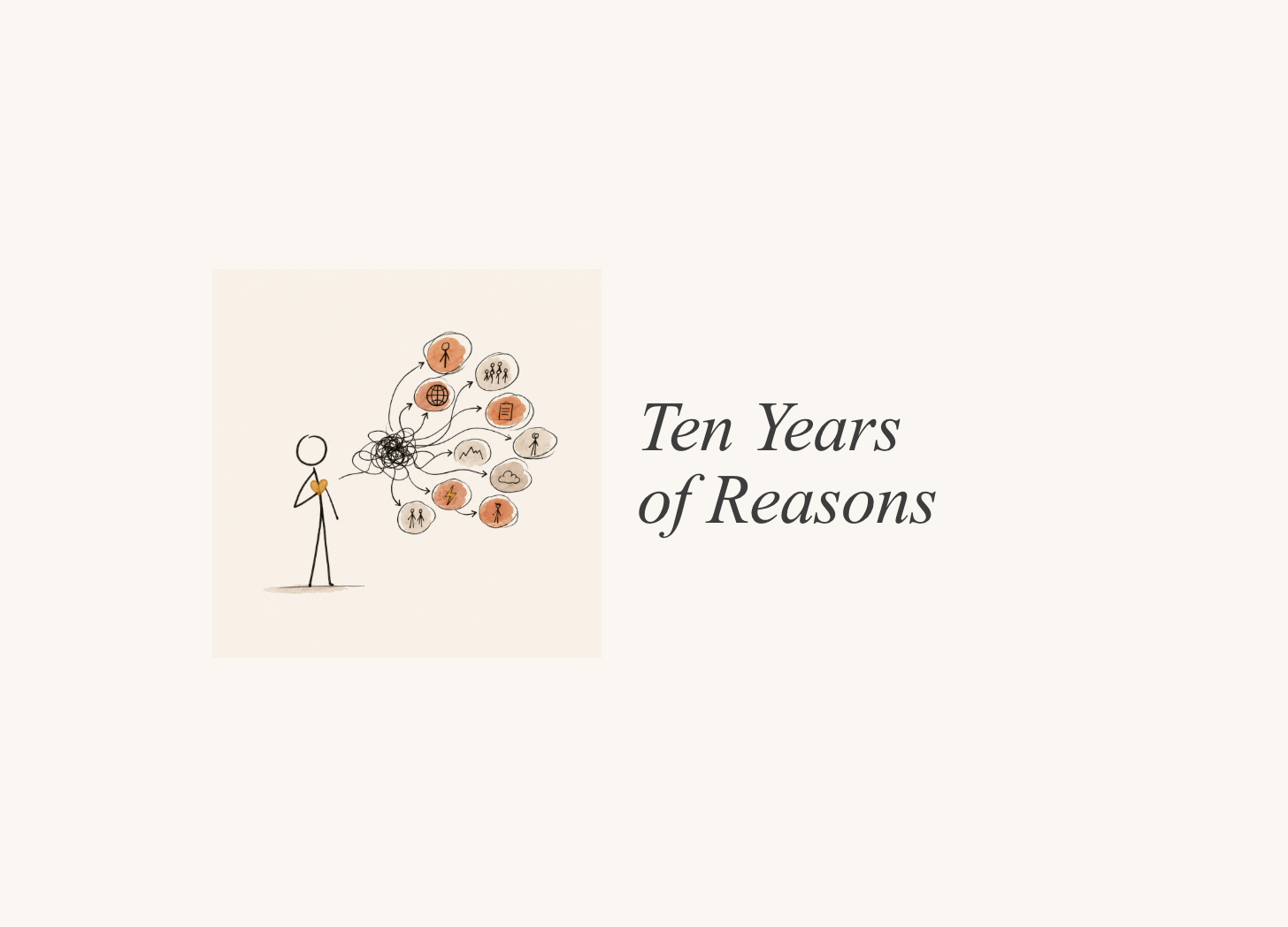
A few weeks ago I got on a call with someone who had ten years of reasons.
She’d been trying to build her business for a decade, and it hadn’t worked, and she had an answer for every part of why.
✔️ The marketers she hired failed her.
✔️ The whole world runs on a belief system stacked against her model.
✔️ Her energy type means traditional marketing can’t work for her.
✔️ She has a chronic illness.
✔️ People won’t invite her in because of her strong opinions.
Every reason was real to her. And every reason lived somewhere outside of her.
At a few points during the conversation I asked her, in different ways, what part she played in any of it. Where, from her own side, the difficulty might live. She couldn’t answer. She kept going back to who she’d worked with, or what the market wouldn’t do for her. Eventually I ended the call, because there was nothing for me to do there.
You can’t help someone who has placed the entire cause of their life circumstances outside their own reach.
I’m not telling you this to make her wrong. I’m telling you because I recognized it. I’ve done versions of it in my own life. We all have.
It points at the thing I actually want to talk about, which is the idea that you are 100% responsible for your life.
Here’s what usually happens when people hear that. Their shoulders go up. They get defensive. It lands as a weight.
If it’s all on me, then I’d better be perfect.
If it’s all on me, where does grace fit, where does the divine fit, am I just alone in here making the whole thing happen?
Carolina Wilke ran an embodiment class on this the other day in our Radiant Flow community and watched a room full of capable people feel that exact heaviness the second the phrase showed up.
So let me take the weight off first, because I believe that the weight is a grave misunderstanding.
Responsibility is not a grade. It’s not a score you get marked down on. The word, if you slow down on it, is response-able.
The ability to respond.
And the thing it stands opposite to isn’t failure. It’s a reaction.
A reaction needs a past in order to exist. We react by running a pattern we already have. Something happens, and before we’ve actually met it, the old story fires in our mind and we’re off, defending, explaining, blaming, and shrinking.
That’s what the individual on the call with me had been doing for ten years. She wasn’t responding to her business. She was reacting to a settled story about why it couldn’t work, and the story was airtight, and airtight stories don’t let new outcomes in.
Reaction have two looks.
One is the obvious one: the blowup, going cold, losing it, the stuff we already call reactive.
The more subtle one is the one that actually runs most businesses into the ground. It’s every unconscious action that isn’t aligned with where you say you want to go. You say you want the online business, then you book the new client into the old in-person model out of habit. You say you want the long game, then you chase this month’s scramble again. That’s reaction too. It just doesn’t look as dramatic.
Now the part that requires honesty, because I don’t want this to flatten into a personal develop or spiritual slogan.
100% responsibility does not mean everything is your fault. A chronic condition is very real. I experienced one for almost a decade.
A hard market is real. Some people carry headwinds that others don’t. The point was never that you caused everything that has happened to you.
The point is that there’s one variable you always hold, which is how you respond, and that variable turns out to be the one that decides the most about what happens next in your life.
You can have a real constraint and still own your response to it. Those two things live in different places. The constraint is in front of you. The excuse is behind you, in the story. It only lives on if you keep giving it new life.
So why does taking this on feel heavy, if it’s supposed to be freeing?
Because most of us, when we reach for responsibility, accidentally reach for control instead. We don’t just own our part. We try to own everyone’s part. We do our work and then we do the other person’s work too. We try to manage how it all turns out, and how other people feel, and whether they make the choice we would make. That isn’t responsibility. That’s control that looks like responsibility on the surface, and it never ends, and it will ultimately wear you out.
Real 100% responsibility is lighter than that, not heavier. It’s owning what is actually yours and letting other people own what is theirs. It’s choosing your response and then letting the outcome breathe. Carolina put it simply:
the power of it isn’t “I will make this happen.” It’s “I will allow this to happen.”
That’s a different meaning entirely that what I believe most people assign. It’s slower. It responds to where you’re going instead of forcing it into being.
And it doesn’t mean alone. Being fully responsible includes responding to support when it shows up. Some weeks the most responsible thing you’ll do is let someone help you.
The practical version is almost embarrassingly simple. Before you act, get underneath the reaction. Find the quieter place that isn’t running the old story, and respond from there. You can put a hand on your chest and actually feel for it. You can ask one question: where am I reacting right now. Not where is the world wrong. Where am I running an unhelpful pattern?
When you ask it honestly, you catch yourself in the script. The market’s not right. I don’t have the audience. This is too hard. It should be faster than this. All of it is reaction. All of it is past-bound. None of it is a response to the thing you said you wanted to build.
The person I spoke to all that call never got to that question. She had built a whole life around the answer being somewhere else, and she defended it to the end, and the cost of that is that nothing could ever change, because in her telling she was never part of the machinery.
You don’t have to live there. You get to respond. That’s the whole invitation with 100% responsibility, and it isn’t a burden. It might be the lightest thing you choose to practice with all year.
Phil (& Carolina)
If you want to see the patterns you tend to react from, that’s most of what our Sacred Business Archetype Quiz shows you. You can take it here.