How to Sell Without Feeling Salesy
I paused on this a few days ago.
Salesy.
What does that word even mean?
When we hear someone say, “I don’t want to sound salesy,” it could mean a hundred different things. And yet we rarely stop to ask.
Through old lenses, through someone else’s experience, through beliefs we picked up somewhere, we decide what a thing is and we never check whether that decision is helping us or hurting us.
Because the charge was never in the thing. Sales, money, marketing — they all hold neutral energy.
The charge is in us.
And we sit so close to our own judgment that it stops looking like a judgment at all. It starts looking like reality.
But nothing is anything until you decide what it means.
You assign the meaning. And then that meaning becomes true for you, true enough to run your business, true enough to shrink your life…
Whether or not it’s true at all.
So the question was never is it true.
The real question is: is it helping me? Is this belief building the life and the business I actually want? Or is it quietly keeping me small and calling it integrity?
Just notice the incoherence:
“I don’t want to sound like I’m selling… but I want to close the sale and get paid for it.”
Read it again.
You want the fruit and you’re at war with the tree. You want to receive, and you’ve made the giving wrong.
So let’s go back to the word. The origin of the word “sell” is to give.
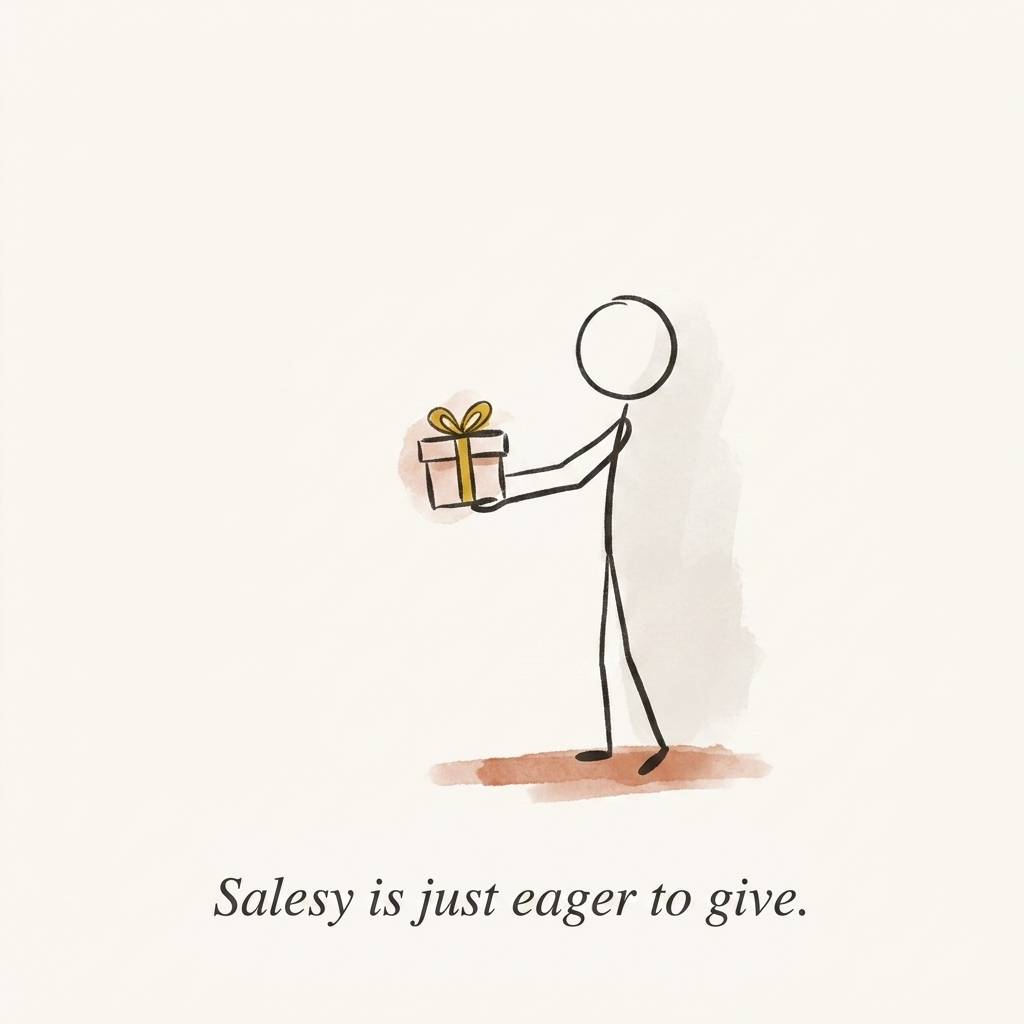
That’s the original meaning — before all the charge, before the eye-rolling, before “salesy,” it simply meant to give, to hand over, to offer. So if we rise above our opinion for one second, salesy isn’t a sin, isn’t bad. Salesy is just… eager to give. I’d call it givy, just for fun.
So maybe you don’t have a problem with sales, if you change what sales means to you. What if sales is the most honorable act to make a service available to someone who needs it? And asking for money in exchange was the most honorable act of allowing someone to pay for something they truly need and appreciate. Giving and receiving at its best.
Change the meaning, change everything.
And forget about what others will think. Their opinion is their movie, their story and often not related to you at all.
Again, we need to pause here and ask: are we going to allow other people’s beliefs to limit us from serving from our heart and sharing something that is truly important to us?
Why? I am sure this is not what your essence is guiding you.
I am becoming unapologetically salesy. In fact, I don’t do it nearly enough — because I love what I’ve built, a business that feels good on the inside and that keeps feeding a life I am excited to live, and I want to help more and more people to do that. Why on earth would I not offer you that if that’s the help you need?
But I wasn’t always here.
I had a very strong negative opinion of marketing. I thought it was forcing, fake, beneath me. I wanted my business to grow without it, purely on essence and good energy. And then I hired a coach because my way wasn’t working, and I saw the truth: that wasn’t integrity.
That was my ego. I wanted the top of the mountain without walking up it. I wanted the result without doing the work. My opinion about sales and marketing was more important than my service.
I had seen people sell in ways that didn’t land for me, and instead of saying “that’s not my way,” I said “that’s the wrong way.” I decided they were pushy, fake, inauthentic, I judged them from the top of my tower, I wasn’t doing anything and judging the ones doing it and decided I didn’t want to look or sound like them but very quietly I desired their results.
But — who am I to judge them like that? I can’t see inside anyone. I don’t know if they’re honest. I don’t know if they’re aching to help. I don’t know their heart. My verdict told me nothing about them. It only told me about me. And it was the wall I was hiding behind. “I’m not like those salesy people” was a very comfortable cage I built.
So let me say it softly, and then say it straight.
If someone out there decides you’re salesy and recoils — that’s their movie. It’s playing in their head, not yours. And the only question that matters is: does living inside their opinion help you give your gift?
You already know it doesn’t.
Does avoiding sounding salesy help your financial situation? Define what sales means to you and sound like someone who is eager to give, to serve, to love unapologetically.
You can feel this in the body, by the way. That contraction right before you make the offer — or the avoidance of writing the email altogether, the one inviting people to discover what you do. Notice it.
Then ask it plainly: is this keeping me safe, keeping me small? Or is it helping me to find more clients? To help more people? Expand my life experience?
You don’t have to sell like anyone else. Please don’t. But you do have to find your own way — clear, true, yours — to say: this is what I give, and this is what it’s worth.
Right now, someone has the exact problem you know how to solve, and they cannot find you. Because you decided you shouldn’t offer your services — that somehow people should just discover you on their own.
It’s just safer for you, and it costs them everything.
So take the opinion — I don’t want to be salesy — and turn it back inward, where the real answers live.
Is it true? You can’t even know. Maybe you don’t want sales to feel natural, as much as it feels when you are helping someone.
If a belief is blocking your ability to give, it is not humility. It’s protection. And now you get to choose what you’re loyal to: the judgment, or the gift.
Then write the email. Make the offer. Say the price.
Give.
Phil (& Carolina)