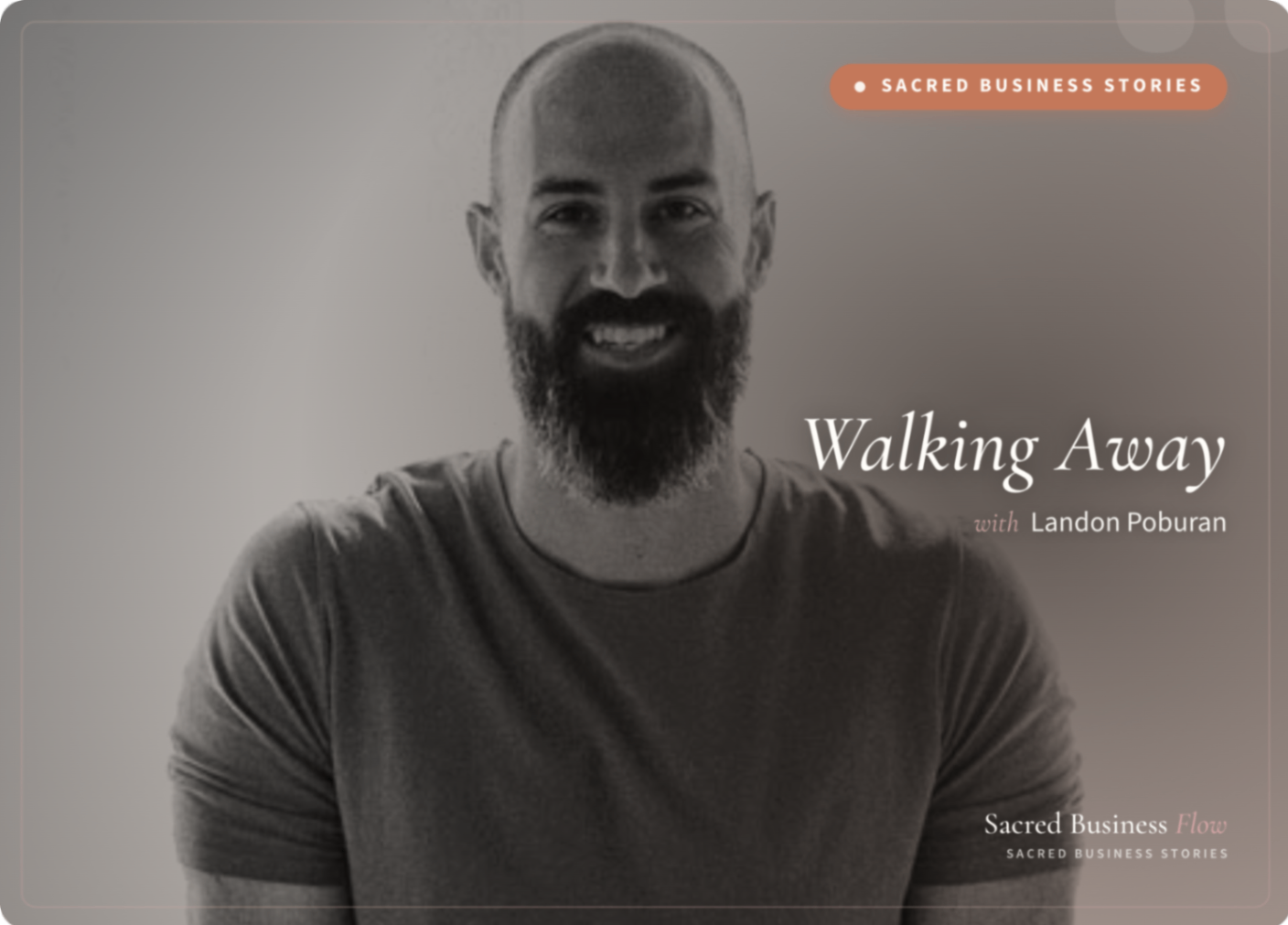
Landon Poburan on Walking Away
Landon Poburan and his wife took out a $500,000 loan and built a 6,000 square foot personal training gym in their hometown.
He had already left a marketing agency behind to do it. Now there was a team of ten to manage and a $15,000 utility bill landing every month.
What he wanted was simple. He wanted work that didn't drain the life out of him.
The hard part came two or three years in, once the gym was actually growing. It was the biggest thing he had ever built, and it was also the thing he dreaded. So he and his wife made the call that scares most people more than failure does. They took on another $100,000 in debt to close a business that worked, and walked away.
We knew it wasn't what we wanted to do.
That was the whole reason. Not the numbers, not a better opportunity waiting in the wings. They just knew. And acting on that knowing cost six figures and several years.
What most people know about Landon is the part that came after. Eighteen years as an entrepreneur. Nine businesses. Fifteen million dollars in paid advertising managed, and more than twenty-five million in revenue generated for clients. Online, people call him the ads guy, or the Substack growth guy. These days he writes Landon's Letters, a Substack with close to four thousand subscribers, and he describes himself as an author, speaker, and coach.
So we had him on Sacred Business Stories to trace the line backward. The part most people don't hear is what the gym cost him after he closed it.
It took close to five years to recover. He was broke, in therapy, and applying for jobs while quietly thinking about burning down the business he was still trying to build. He had spent those years copying the popular blueprints, the three secrets and the five-step frameworks and the promise of ten thousand dollar months, and getting almost none of the results they sold.
What pulled him out wasn't a better blueprint. It was a smaller one. His therapist handed him Four Thousand Weeks by Oliver Burkeman, and a concept inside it that Landon now builds everything around: radical incrementalism.
These micro improvements are always going to be better than trying to take big swings and start and stop.
He calls his own version minimal viable habits. Some days he writes a thousand words. Some days he writes seven, punched into a note on his phone. Both count. The point is to build the things that move you forward in a form you can still do on your worst day.
Two things stood out from the conversation.
The first was his answer when another podcast host asked what had helped his business the most.
Therapy.
He doesn't separate the person from the company, because for a solopreneur there is nothing to separate. We are the business, he said, so the more he grows as a person the more he can take the risks the work asks of him. Most people treat self-work as the reward they will get to once the business is stable. Landon treats it as the thing that makes the business possible at all.
The second was about failure, and how he refuses to package it. A mentor once told him to wait until he had fixed a failed product launch before writing about it, so he could tell the clean turnaround story. He said no.
Sometimes we're just like in the shit for a while.
When you only talk about hard times once they are tied to a happy ending, you teach people that the reward is always coming. Then theirs doesn't arrive on schedule, and they feel defeated. So he writes the failures while he is still inside them.
The line underneath all of it is freeing, and plain.
Most people are too wrapped up in what's going on with themselves to even care what's going on with us.
The reframe in Landon's story is worth naming. He hit the income, the hours, and the goals he had written down, and still felt like he was striving toward something he couldn't name. What was missing wasn't a bigger number. It was alignment with the work itself.
Which flips a belief a lot of people build on, the idea that you earn the right to enjoy your work later, once the money is handled. Landon's experience runs the other way. Everything works, as he puts it, for the person it was built for. The job was never to find the blueprint that worked for someone else. It was to build the one that fits you.
You can find Landon writing at Landon's Letters on Substack, and working with a small number of clients through landonp.com.
He writes mostly for solopreneurs, coaches, course creators, and writers who want income they control without burning themselves down to get it. If you have ever run a guru's plan and wondered why their results didn't copy over, he is talking to you.
Check out the full replay. He is an open book, and he doesn't dress up the hard parts.