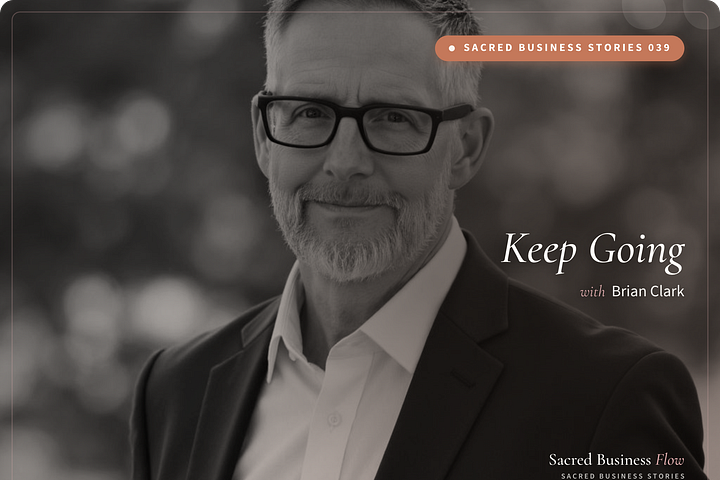
The snowboarding accident landed Brian Clark in surgery for a subdural hematoma. He had a wife, a three-year-old daughter, and a new baby son who’d just arrived.
What he wanted was simple. He didn’t want to keep spending his life on work he hated.
The hard part was that his real estate brokerage had just become the first business he’d ever built that made more money than his big-law job would have. He had something to prove with it. And now, recovering from brain surgery, he was thinking hard about everything he didn’t actually want to spend his life doing.
I’m not doing this anymore.
Those were the words. Shocking, in his telling, because of the family he now had to feed. But clarity arrives fast when you’ve just been that close to the edge.
What came next is the part most people already know in some form, because Brian is the founder of Copyblogger. He built three seven-figure no-employee businesses in three years, combined them into what became an eight-figure software and hosting company, did $70 million in sales between 2007 and 2017, and sold in 2018. Then, at an age when most of his peers were talking about retirement, he started a Substack called Further, built for the generation that employers start pushing out the door somewhere between 58 and 62.
So we had him on Sacred Business Stories this week to trace the arc. The part most people don’t hear is what happened before the wins.
He'd quit law in 1998. His first business failed. It was an email newsletter company, which, as he pointed out, is roughly the same thing everyone on Substack is doing in 2026. He just got there 28 years too early and didn't understand how to sell anything. He thought you monetized content with advertising, but he later proved businesses could grow organically by delivering valuable content first and building an audience before launching products. The dot-com crash ended it for him, and in his words, that was a mercy killing.
Then he read one line in Seth Godin’s Permission Marketing.
The Internet is the greatest direct marketing medium the world has ever seen.
That was the sentence that reset his path. He taught himself empathy-based copywriting rooted in psychology and became a serious student of direct response, paying close attention to what people need, what makes them trust, and how media keeps changing. He kept working to learn as the tools changed, and he put a premium on owning the audience through email lists instead of handing that job to platform algorithms. By the time Brian Clark founded Copyblogger in 2006, it had the start of a history that would make it influential in content marketing, with Brian as a recognized pioneer pushing audience-centric content built on authentic consumer trust instead of spam tactics.
Two things stood out in the conversation.
The first was a quote that’s stuck with me since we recorded.
“Technology doesn’t change human nature. It amplifies it.”
Apply that anywhere you like. AI, Substack, the dopamine feed on whatever platform ate your morning. The useful question is what side of you a given tool tends to amplify.
The second was about values-based marketing. Brian made the point that values aren’t automatically good. Greed is a value. Figures like Andrew Tate have audiences because they’re marketing with precision to the values of those audiences, and it’s been okay on the internet for a long time, in his words, to be awful. Which means writers who sit on their message because they’re worried about being disliked are making the problem worse. They leave the space empty. Somebody fills it. Usually not someone you’d want doing the filling.
His advice to anyone hesitating was unfussy.
If you try to create generic content because you’re afraid to say anything that matters, you will not succeed.
The shift Brian made after the brain surgery is worth naming clearly. He stopped building from an energy of having something to prove. He started building something he actually cared about. The irony, as he put it, is that the decade after that shift is the one that produced the $70 million.
Which reframes a belief a lot of people carry into their work. The idea that purpose and practicality pull in opposite directions. Brian’s experience says they pull in the same one. The decade he made his most purpose-aligned decisions was also the decade he made the most money.
You can find Brian writing at news.further.net.
He speaks mostly to 45 to 70 year olds who aren’t ready to retire and aren’t going to be allowed to coast much longer either. Gen X, in his framing, is the canary in the coal mine for what happens next.
Check out the fully replay. He doesn’t waste the hour.