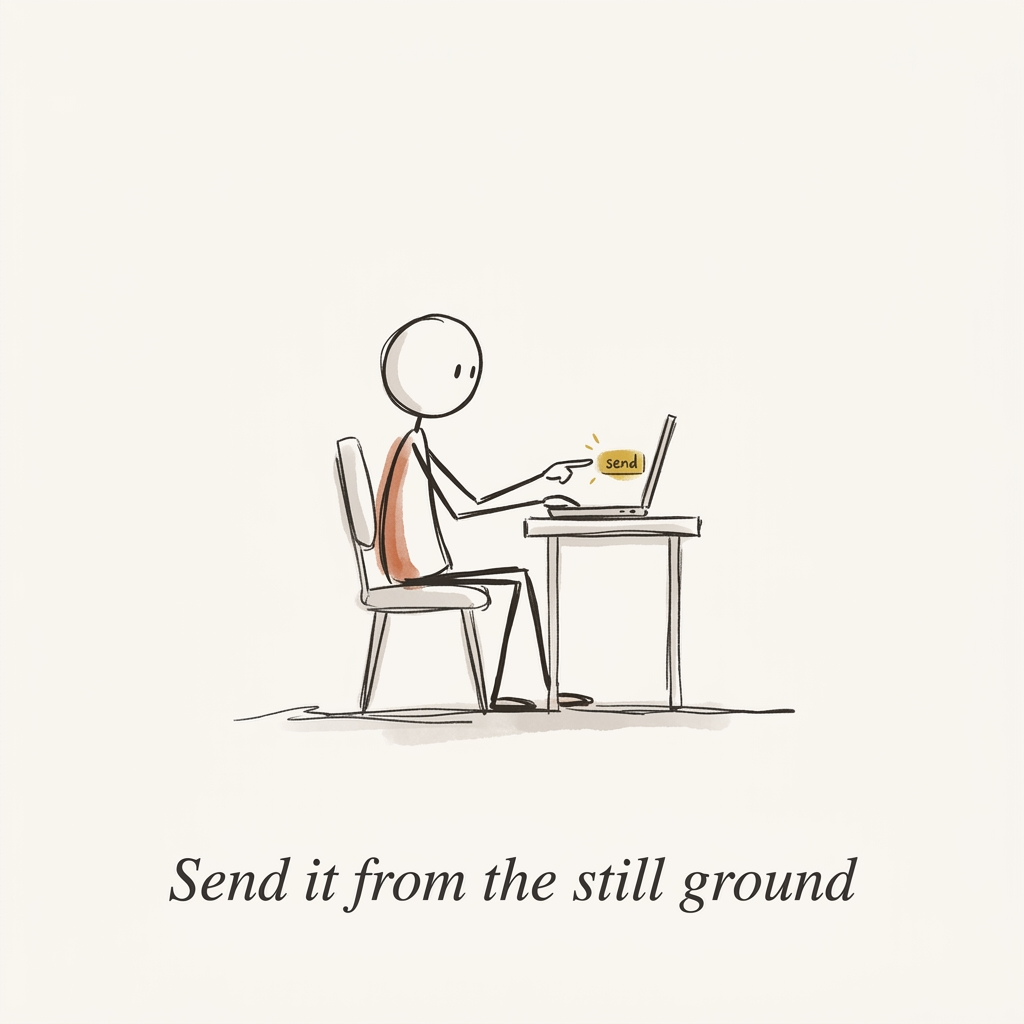
I had the email written and Brad Smith's name sitting in the to-line. My cursor was on the send button, and it wasn't moving.
Brad ran Intuit for eleven years. He's the president of Marshall University now, and he sits on Amazon's board. I was inviting him onto the Sacred Business Stories show. Simple ask. And I noticed something in my body I hadn't felt in a while. I was feeling small.
Put me in a room of coaches or online service providers and I'm steady as can be. I've worked in this world for a decade, made good money in it, and I can speak with authority and confidence in a way that allows my shoulders to stay relaxed. But the vision Carolina and I have for Sacred Business Flow reaches beyond the comfort of that room.
And the second I aim at creating a conversation with someone like Brad, I notice myself shrinking on the inside.
This was a ceiling that I couldn't see for myself until recently. I think we all have a version of it, running underneath our days, that remains mostly invisible to us.
What got me to hit send wasn't a pep talk. I didn't hype myself up. I got underneath the fear first, to a place that I was able to experience my own steadiness, and I sent it from there. He said yes, by the way. Scheduling TBD.
That place is what I want to talk about. I've come to think of it as the still ground, and the more I work with clients the more I'm convinced it sits underneath almost everything else. You find it first. Then you build from that space. Then you use your relationship with it to help guide you in knowing when there's a real reason to pause, or when it's just fear showing up again.
a reaction needs a past
Carolina teaches a version of this in her embodiment classes we offer within Radiant Flow. A reaction, she says, needs a past. It's the old story firing before you've looked at what's actually in front of you. The thought of sending that email to Brad brought up every version of me that ever felt not-enough in the past. None of that was happening on the computer screen as I considered my words. It was happening only in my mind as a remnant of my own personal history.
So the first move is to get under the story. Not to argue with it, not to push it away. Just to drop beneath it, to the part of you that was there before the fear had a name.
This is also where taking 100 percent responsibility for your own experience stops feeling heavy. Inside the reaction, taking responsibility feels like carrying everyone and everything at once. From the still ground it gets light, because you own your part and you let other people own theirs. Carolina calls the power there "allow, not make." You stop forcing an outcome and start responding to what you actually want, with steady footing.
You can't think your way to this with logic alone. You get there through getting in touch with the body. A few slow breaths before you open the laptop. A walk before the call. Whatever it takes for your nervous system to register that you're safe, before you make a big decision, or take the very next step.
build from there, don't chase
Once you're standing on that ground, the way you are able to move forward changes.
From fear, you chase. You take the fast money, you discount yourself to close the deal, you grab the quick win because your bank account balance dipped for three days and you really want it to show a different number. I know moves like this well. I built a business past a 100K a month running on exactly this style of engine, and it nearly cost me my health.
From the still ground, you can take the quick win and lay the rail for the long game in the same motion. You can start holding yourself as the prize. Same business, same week, same sales dashboard. The only thing that changes is the ground you're standing on when you make the next move. If you are on still ground, your intuition will speak to you loud and clear. You just need to listen.
This is the part that's easy to skip. You do a little breathwork, feel calmer, then go right back to building from the same scarcity. The ground isn't a retreat or a hiding place you go when the world gets loud, or you are feeling overwhelmed. It's the place you act from.
the same stillness tells you when to leave
This is where it gets useful, and perhaps a little dangerous.
The still ground is also how you discern a true pivot from a temporary escape from discomfort. Carolina also has a word for how to read the situation. Flat. When you sit in stillness and look at the bigger picture, the thing you're building, and your relationship with it feels flat from that calm place, that's useful information. It might be time to change direction. When it still feels alive within you, but the daily work is hard, that's not a signal to quit. That's the work asking you to hold the plank a little longer.
The trap is reading the situation from within a burning room instead of from the ground. Get yourself to safety first. Then take stock of your situation. In the middle of a rough launch everything feels flat. Of course it does. You're spent and maybe your numbers are down from last year. Decide from there and you'll walk away from something that still has life and call it intuition.
So make your assessment from stillness, never from within the fire. And move slowly. This is not the time to move fast. A real change of direction deserves the same care you used to arrive at the vision in the first place, not a snap call on a bad afternoon when everything feels like shit.
the thorn that stopped hurting
There's a version of this that's harder to catch, and it's the one I keep finding in myself and in the people I work with in our community.
Michael Singer, in The Untethered Soul, writes about the inner thorn, the tender spot a person can build a whole life around protecting. Carolina put an image on it during our last Wonder Questions call. A splinter that's been under the skin long enough stops hurting. You've built ways to work around it without touching it directly. You hold yourself a certain way to keep from pressing on it, and after a while you don't feel it at all. You barely notice it.
That invisible ceiling with Brad was one of mine. It didn't hurt. It wasn't loud, or staring me in the face. It was simply running in the background as a comfortable feeling about who I am qualified to work with, and be in relationship with. There was no sharp fear to drop beneath, because it had stopped registering as fear. It was just operating below the surface of my everyday decision making about who to reach out to next for our show.
That's the catch with the still ground. Once you get good at finding peace in your everyday experience, peace itself can become the place you hide. The most spiritually practiced people I know are often the most skilled at staying safe and calling it being centered. The ultimate peace is death. If you want to be alive and making things as a creator, stillness can't mean retreat.
So Carolina asked our community an even sharper question on that call. Am I at peace because I'm protecting the thorn, or am I at peace because I finally took the leap towards something important?
I think most of us equate peace with quiet, stillness, and a slow, gentle feeling, and that's the trap. In this scenario, one is the calm of staying safe behind the desire you've never let yourself get close enough to touch. The other is the calm that arrives on the far side of a brave action, once you've already leapt off the cliff instead of backing away from the edge.
You tell them apart with the same flat-versus-alive read that I mentioned in the launch example. Real peace is not devoid of life or movement. The hiding kind is flat, and it's been flat so long you stopped noticing it was there. You just have to slow down enough to be honest about which one you're standing in.
what to do before your next real decision
So here's one small thing, the one I'd love for you to try in your own life.
Before your next real decision that you need to make in the business, take stock of where you're standing. Get to the still ground first. Take the walk, take a few breaths, do whatever drops you below the story. Then, from there, ask yourself these two questions:
Is this flat because it's genuinely a chapter that has run its course, or flat because I'm protecting something I stopped allowing myself to feel years ago?
And, do I need this, or do I want it? In my example, the Brad email failed the need test. I didn't need to send it. But the want was incredibly real, even with the fear sitting right next to it. That was enough for me to know I needed to hit send.
Stillness is not the prize you earn at the end of doing something hard. It's the ground you do the hard part from, not the reward for finishing it. You find it. You build momentum from it. And every so often you use it to feel a splinter you've been protecting for years, and you start to work it out gently.
If you try this before your next real decision, I'd like to hear what came up. What did you notice when you got still and asked? Reply to the email or drop it in the comments on Substack and tell me. I would love to hear what you're sitting with.
I'll send you all tweezers in the mail. Keep an eye out.
Phil (& Carolina)