Maya had a gift for helping people calm their nervous systems. Her clients told her sessions changed their week, sometimes their whole season of life. But her business still felt shaky. She'd post when she felt inspired, change her offer every few months, and undercharge because charging more felt off. She wasn't missing purpose. She had plenty of that. What she was missing was the structure a purpose driven business needs if it's going to support both the work and the person doing it.
That's the part people don't say clearly enough. Purpose is not the business model. Purpose is the reason. The business still needs shape.
If you're a coach, healer, therapist, or guide, you may already know this in your bones. You can feel the difference between work that matters and marketing that performs. You don't want to sell with pressure. You don't want to become someone louder and harder just to get clients. Good. You don't need to. But you do need to stop treating purpose as if it should automatically create consistency. It won't.
A purpose driven business still needs to work
Let's make this plain. A purpose driven business is not a softer version of a business. It's still a business. Money has to come in. Clients have to know what you're offering. Your work has to solve a real problem in a way people can understand.
This is where many thoughtful, spiritually aware business owners get stuck. They care deeply about the work. They have training. They have wisdom. They've done years of inner work. But when it comes to the actual business, they stay vague.
They say things like, "I help people come home to themselves," which may be true, but it doesn't tell a potential client enough. Or they create offers based on what feels good to deliver, not what people are ready to buy. Or they wait until they feel fully aligned before taking the next step, which can quietly become a high-minded form of avoidance.
And yes, that's the unsaid thing. Sometimes "alignment" is real. Sometimes it's fear with incense on it.
A business with purpose needs translation. You have to turn the deeper truth of your work into language, offers, pricing, and decisions people can actually respond to.
Purpose without structure creates strain
When there's no structure, purpose starts carrying too much weight. It has to motivate you, steady you, guide your marketing, justify your prices, and somehow make up for the fact that your business has no rhythm. That's a lot to ask from one beautiful idea.
This is why people end up exhausted inside work they love. Not because the work is wrong, but because the container is weak.
A weak container shows up in ordinary ways. Your offers are too broad. Your message changes depending on the day. Your content sounds wise but doesn't lead anywhere. You get clients through referrals, but you don't know how to create steady demand. So every quiet week feels personal.
And then your nervous system gets involved. You start thinking the problem is visibility, or confidence, or money wounds. Sometimes it is. But just as often, the business is simply missing a few basic decisions.
What do you sell?
Who is it for?
What result are they hiring you for?
How do they move from finding you to working with you?
Those aren't cold business questions. They're caring questions. They create safety for you and for the person considering your work.
The real job of a purpose driven business
The job of a purpose driven business is not to prove that you're good. It's not to display your depth. And it's not to perfectly mirror every part of your calling.
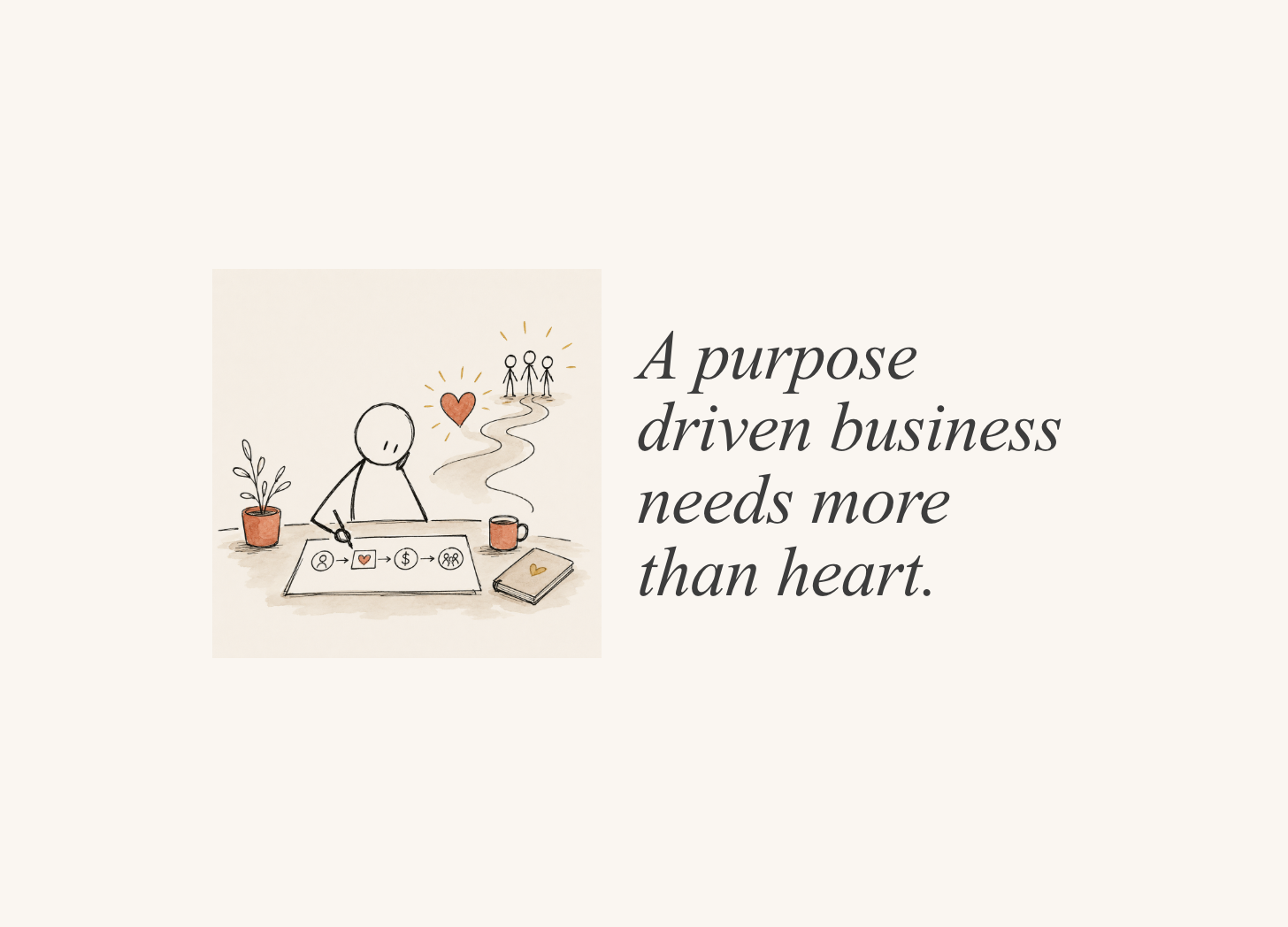
Its job is simpler than that. It needs to create a clear path between your work and the people who need it.
That path usually has four parts.
First, your work has to be legible. People need to understand what you do in normal words. Not because your work is ordinary, but because confused people rarely buy.
Second, your offer has to meet a real moment in someone's life. A person doesn't buy coaching because your method is profound. She buys because she's stuck in a problem she wants help solving now.
Third, your business needs repetition. You cannot rebuild the whole thing every month based on mood, astrology, or one weird week on Instagram. Some things have to stay stable long enough to work.
Fourth, you need the capacity to receive. That means being able to handle being seen, being paid, being chosen, and being responsible for results. This is where strategy and inner work meet for real.
So if your business feels inconsistent, ask yourself an honest question. Is the issue that your purpose isn't clear? Or is it that your business has never been built to hold it?
Why good people stay stuck
A lot of smart, caring practitioners stay stuck for one reason. They keep trying to solve a structural problem with emotional effort.
They try to feel more confident instead of clarifying the offer. They try to heal the visibility wound instead of making a plan for being seen every week. They try to get more aligned instead of choosing one audience and one clear message.
And to be fair, the inner work matters. It matters a lot. If being visible brings up shame, if charging brings up grief, if commitment brings up an old pattern of self-abandonment, you can't just bulldoze through that. You'll either burn out or sabotage the very thing you're trying to build.
But inner work is not a substitute for business design. It supports business design.
This is why at Sacred Business Flow, we keep seeing the same shift happen. The moment someone has both pieces in the room, things start moving. Not because she suddenly becomes fearless. Usually she doesn't. Things move because now the fear isn't driving the structure.
What to build first
If you're trying to grow a purpose driven business, start smaller than your mind wants to.
Don't begin with the full brand vision, twelve offers, a new website, or a giant content plan. Start with the clearest expression of the work that already gets results.
Look at the people you've helped best. What were they coming in with? What changed for them? What did they actually say yes to?
That last question matters. Many business owners describe their work at the deepest possible level, but clients often buy at the level just above that. They come for burnout, grief, relationship patterns, leadership strain, business confusion, or a body that no longer feels safe. The deeper transformation may be identity, worth, trust, or spiritual connection. Both matter. But your offer has to start where the client starts.
Then make the offer simpler. One audience. One problem. One clear path. You can have more later. Right now you're building trust, not a museum.
And give your business a rhythm. Choose how often you'll share your work, how people can work with you, and what happens after someone reaches out. It doesn't have to be fancy. It does have to be repeatable.
The trade-off no one likes
Here's the trade-off. The clearer your business gets, the less room there is to hide in complexity.
A broad, mystical message can feel safer because no one can quite reject it. A clear offer can feel more exposed because now people understand what you're asking them to choose.
So yes, building a purpose driven business can feel strangely vulnerable. Not because it's less spiritual, but because it asks for embodiment. It asks you to let your work become visible in concrete form.
That might mean naming a price without apologizing. It might mean repeating the same message for six months instead of changing it every week. It might mean admitting that your gift needs a business model if it's going to keep serving people.
And if part of you resists that, that makes sense. For many people, structure has been tied to control, pressure, or performing. So when you build structure now, do it differently. Build it as support. Build it as devotion. Build it as the thing that lets your work stay in the world longer.
Because that's really the point. A purpose driven business isn't noble because it's purpose driven. It's useful when it helps you do your work well, get paid fairly, and keep going without resentment.
So if your business has heart but no traction, don't question the heart first. Look at the container. Make the work easier to understand. Make the offer easier to choose. Make your actions easier to repeat. Then notice what changes when purpose stops doing all the heavy lifting alone.
Your work may be sacred. And it still needs a calendar, a price, a message, and a path. That's not a betrayal of the work. It's one way you take care of it.